Veliko Tarnovo looks like nowhere else in Bulgaria. You don't come here for a beach; you come for a history lesson written in stone and draped across three hills above a gorge where the Yantra river carves tight loops through the rock. This was the capital of the Second Bulgarian Empire from the twelfth to the fourteenth century, and Bulgarians still call it, simply, "the city of the tsars". The white houses with their red roofs seem glued together, climbing one over the other's shoulder up the steep slopes like an inhabited amphitheatre. It is, without exaggeration, one of the most scenographic towns in the Balkans.
For travellers from Romania, Veliko Tarnovo has one huge advantage: it's close. You reach it within a few hours of the border, and now that Romania and Bulgaria are both in Schengen, the land crossing happens with no passport or ID checks at all — you simply cross the Danube and keep driving. It's an ideal destination for a two- or three-day city break, or as the centrepiece of a longer route through northern Bulgaria.
Why Veliko Tarnovo is worth it
Many Bulgarian towns offer you either coast or mountain. Veliko Tarnovo offers something else: historical density and a drama of landscape few places can match. The Tsarevets fortress dominates everything from its hill, the painted churches of Arbanasi hide ceilings of unexpected richness, and the craftsmen's street carries you back to the nineteenth century, when the town was a heartland of the Bulgarian national revival.
There's one more thing that sets it apart: pace. Unlike the crowded coastal resorts — Sunny Beach, Golden Sands, Albena — nobody rushes you here. Veliko Tarnovo is a place to explore on foot, slowly, with frequent stops for a coffee on a terrace hanging over the abyss.
Tsarevets fortress
Tsarevets is the heart of the town and the main reason most visitors come. Set on a hill almost entirely wrapped by the loop of the Yantra, the fortress was the residence of the Bulgarian tsars and the seat of the patriarchate. Today you enter through a massive gate and climb cobbled paths among the ruins of the royal palace, the boyar houses and partly rebuilt defensive walls.
At the summit stands the Patriarchal Cathedral of the Holy Ascension, reconstructed in the twentieth century and decorated inside with modern, expressionist frescoes of unusual drama — a striking contrast to the traditional Byzantine painting you see elsewhere in the country. The climb takes some effort, but the panorama from the top, with the town spilling over its hills and the river snaking below, rewards every step.
At the northern tip of the hill stands the Execution Rock (Lobnata skala), from which, according to the chronicles, traitors were thrown into the Yantra. The spot has a dizzying view and a grim story that stays with you.
The Sound and Light show
In the evening, Tsarevets becomes the stage of a Sound and Light show (Zvuk i svetlina) well worth planning around. The whole fortress is lit in colours, lasers and projections, set to music and bells, evoking key moments of Bulgarian history — the glory of the empire, the fall to the Ottomans, the national revival. It does not run every evening or at a fixed hour year-round; the schedule depends on the season and is sometimes triggered only by group bookings. Check the timetable on site or at the tourist information centre before making plans — times are indicative and vary. The best vantage points are from one of the old-town terraces or the area facing the fortress.
The houses above the Yantra gorge
Beyond the fortress, the town's great attraction is its very architecture. The old quarter clambers up the slopes in a way that defies gravity: multi-storey houses built in the Bulgarian revival style, with upper floors jutting out over the streets in cantilever and windows that look straight into the void. Seen from the far side of the gorge, they appear to grow out of one another.
The finest views of this tableau come from several spots:
- From Gurko Street, one of the oldest and most photogenic lanes, stone-paved and lined with houses clinging to the edge of the precipice.
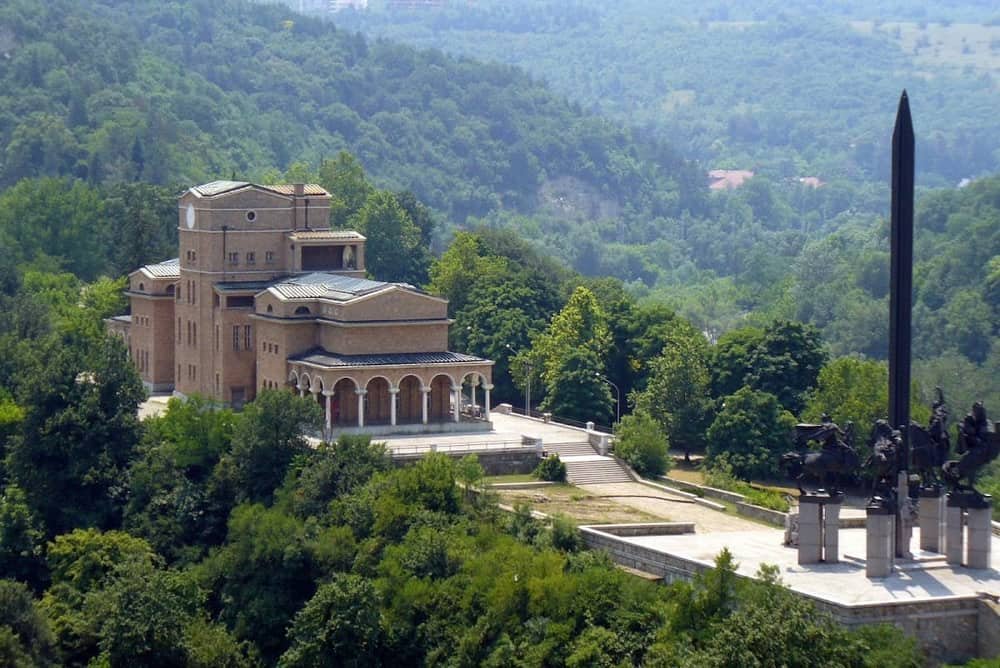
- From the Asenevtsi monument (the Asen dynasty), an imposing sculptural ensemble raised on a spur of rock, with a giant sword pointed at the sky, dedicated to the dynasty that refounded the Bulgarian state.
- From any of the bridges and viewpoints that cross or face the Yantra.
Wandering these narrow streets with no particular goal is one of the most rewarding things the town offers.
Samovodska Charshia — the craftsmen's street
In the heart of the old town lies Samovodska Charshia, a former trading market now reborn as a quarter of workshops and small shops. Here the Bulgarian revival isn't just a museum but a living trade: potters shaping clay at the wheel, blacksmiths, knife-makers, icon painters, weavers, confectioners making traditional sweets before your eyes.
It's the ideal place to buy something genuine — glazed ceramics, a hand-worked wooden object, a jar of mountain honey or rose oil from the Rose Valley near Kazanlak. The atmosphere is relaxed, without the aggressive pressure of resort souvenir markets. You'll also find a handful of cafés and small restaurants set in old buildings, perfect for a break.
Arbanasi and its painted churches
Just a few kilometres from town, on a high plateau, sits the village of Arbanasi — a half-day excursion you shouldn't miss. At first glance it looks like a quiet village of large stone houses hidden behind high walls, like little fortresses. But its treasure lies inside.
The Church of the Nativity (Rozhdestvo Hristovo) is, without question, the star. From outside it looks modest, almost like a house — churches under Ottoman rule were not allowed to be tall or conspicuous. Inside, however, every inch of wall and ceiling is covered with frescoes: more than a thousand biblical scenes, a calendar of saints, a famous "Tree of Jesse". It is one of the most richly painted churches in Bulgaria and alone justifies the trip.
Also worth a visit is the Konstantsalieva House, a boyar mansion turned museum that shows how a wealthy Arbanasi family lived in centuries past. From the plateau you also get superb views back towards Veliko Tarnovo and the Tsarevets fortress.
A suggested two-day itinerary
Day 1 — the old town and the fortress. In the morning, stroll Gurko Street and Samovodska Charshia, stopping in the workshops. For lunch, eat in a traditional restaurant in the old quarter. In the afternoon, visit Tsarevets — allow at least two hours. In the evening, if the schedule allows, catch the Sound and Light show from a terrace.
Day 2 — Arbanasi and around. In the morning, take the trip to Arbanasi: the painted churches and the Konstantsalieva House. On the way back, see the Asenevtsi monument and spend the rest of the day exploring at leisure. Those with an extra day can add an excursion to the Krushuna Falls, less than an hour away, one of the loveliest waterfalls in Bulgaria.
Where to stay
The most inspired choice is the old town, near Gurko Street and Stefan Stambolov Street. Here you'll find family guesthouses and small hotels set in revival-era houses, many with balconies facing the gorge or the fortress. The advantage is that everything is a few steps away and you catch the panorama of Tsarevets lit up at night, straight from your window.
For those arriving by car, the outskirts offer newer accommodation with private parking — an important detail, since the old streets are narrow and parking there is difficult. Prices are generally far lower than on the coast, especially outside the summer season.
What and where to eat
The cuisine of Veliko Tarnovo is robust, drawing on traditional Bulgarian cooking with northern accents. A few things to try:
- Shopska salad — the unmissable classic: tomatoes, cucumber, pepper, onion and grated sirene cheese on top.
- Banitsa — a pastry of thin filo layers with cheese, perfect at breakfast.
- Kavarma — a slow stew of meat and vegetables, served in a clay pot.
- Grills (skara) — kebapche and kyufte, the local minced-meat sausages and patties, everywhere.
- Local wines — northern Bulgaria has good vineyards; ask for a regional red, or try the homemade rakia, in moderation.
Look for restaurants called "mehana" — the traditional taverns, often with terraces above the gorge. One of the town's great pleasures is dining on a hanging terrace as the fortress lights up in the distance.
Getting there
By car is the most convenient option, especially for travellers from Romania. From the Danube you arrive within a few hours on serviceable roads. A few essentials to keep in mind:
- An electronic vignette is mandatory for driving on Bulgarian roads. Buy it online or at petrol stations and border points before entering the main roads. Check the validity and price, which vary.
- Fuel costs around 2 euro per litre (indicative, petrol and diesel), generally comparable to or slightly cheaper than in Romania.
- Bulgaria's currency is now the euro, though the lev still circulates in parallel during the transition. Card payment is widely accepted in town.
- Thanks to Schengen, there is no passport control when crossing the land border between Romania and Bulgaria.
By train or coach, Veliko Tarnovo connects to Sofia, Varna and other major cities. The main station sits somewhat below the historic centre, so be ready for a climb or take a taxi.
Once there, the town is explored on foot. Distances are short, but the terrain is hilly — wear comfortable shoes. For Arbanasi, a few kilometres out, you'll need a car, taxi or organised tour.
Practical tips
- The best time to visit is late spring or autumn, when the weather is mild and the crowds thinner. Summer can be hot, and the climbs grow demanding at midday.
- Comfortable shoes are non-negotiable — the old paving and the slopes demand them.
- Book early for summer weekends, and check the Tsarevets show schedule in advance.
- Combine Veliko Tarnovo with nearby destinations: Arbanasi, the Krushuna Falls or, if you head further south, Plovdiv. That turns a city break into a small circuit through the heart of Bulgaria.
Veliko Tarnovo is in no hurry, and it won't let you hurry either. It's a town you discover step by step, looking up to the fortress and down to the river, with the constant sense that you're walking through a page of history that is still alive.
FAQ
What is the Tsarevets fortress and how long should I allow? Tsarevets is the heart of the town, the former residence of the Bulgarian tsars and seat of the patriarchate, set on a hill wrapped by the loop of the Yantra. At the summit stands the Patriarchal Cathedral of the Holy Ascension, with modern expressionist frescoes. Allow at least two hours to climb among the ruins to the panorama at the top.
When is the Sound and Light show? The show (Zvuk i svetlina) lights the fortress in colours, lasers and projections set to music, but it does not run every evening or at a fixed hour year-round — the schedule depends on the season and is sometimes triggered only by group bookings. Check the timetable on site or at the tourist information centre; times are indicative.
Is the Arbanasi trip worth it? Yes, it is a half-day excursion a few kilometres from town. The star is the Church of the Nativity, modest outside (churches under Ottoman rule were not allowed to be tall) but with every inch covered by more than a thousand biblical scenes. The Konstantsalieva House, a boyar mansion turned museum, is also worth it.
How do I get to and around Veliko Tarnovo? By car, you reach it within a few hours of the Danube with no border control (Schengen); an electronic vignette is mandatory and fuel is around 2 euro per litre (indicative). The town is explored on foot, but the terrain is hilly — wear comfortable shoes. For Arbanasi you need a car, taxi or organised tour.