Why Sofia
Sofia reveals itself slowly and stays with you easily. It is a capital that does not assault you with postcard monuments at first glance; instead it lets you turn a corner and find, side by side, a Roman basilica, an Ottoman mosque, a Sephardic synagogue and an Orthodox cathedral crowned with golden domes. It is one of the oldest continuously inhabited cities in Europe — the Romans' Serdica — sitting at the foot of Mount Vitosha, which you glimpse almost everywhere, above the rooftops, like a blue-green wall.
For a traveller arriving from Romania, Sofia is now surprisingly close. Romania and Bulgaria are both in the Schengen area, so at the Danube land border there is no longer any passport or ID check — you cross as if moving between two counties. And as of 2026 Bulgaria's currency is the euro; the lev still circulates in parallel during the transition, but prices are increasingly shown in euros. In short: same currency, no border queues, just a few hours' drive from Bucharest or Craiova.
This guide covers a classic two-to-three-day city break: what you must see, which neighbourhoods to wander, where to sleep and eat, how to get around, and a handful of day trips well worth the detour.
The headline sights
Alexander Nevsky Cathedral
This is Sofia's picture-postcard image and, rightly, the first stop on any list. Built in the early twentieth century in memory of the Russian, Romanian, Bulgarian and Finnish soldiers who fell in the War of Liberation, Sveti Aleksandar Nevski is a vast neo-Byzantine cathedral whose gilded domes catch the light from far off. The interior is dim, thick with incense, layered with mosaics, icons and marble brought from several countries. Entry to the church is free; photography usually carries a small fee, and the crypt below, holding one of the world's finest collections of Orthodox icons, has a separate ticket. Dress modestly (shoulders covered) and keep your voice low — it is a working place of worship.
St Sofia Basilica
A few steps from Nevsky stands the church that gave the city its name. Sveta Sofia is a red-brick basilica of an almost Roman austerity, raised in the sixth century over older sanctuaries. Above ground it looks plain; beneath it, however, lies a visitable early-Christian necropolis with tombs and mosaics from the days of Roman Serdica — go down, it is worth it. Outside burns the flame of the Unknown Soldier, guarded by a stone lion.
The Roman ruins of Serdica
Sofia carries its Roman city beneath its own feet, and in recent years it has brought it elegantly to the surface. At the Serdika metro station, below street level, an open-air complex lets you walk among paved streets, walls, baths and building foundations of ancient Serdica — the city so dear to Emperor Constantine the Great, who is said to have declared, "Serdica is my Rome." The visit is free and self-guided, woven directly into the modern urban fabric: trams overhead, Roman roads underneath.
Vitosha Boulevard
Vitoshka, as locals call it, is the city's main shopping artery and the soul of its promenade culture — a pedestrian boulevard sloping down toward the mountain, lined with shops, café terraces and handsome buildings. At its far end, on a clear day, the Vitosha massif closes the view like a painting. It is the ideal place for a morning coffee or an evening aperitivo, with people at the tables and the mountain in the distance. Here and on the side streets you will find the densest concentration of good bars and restaurants in the centre.
The National Palace of Culture (NDK)
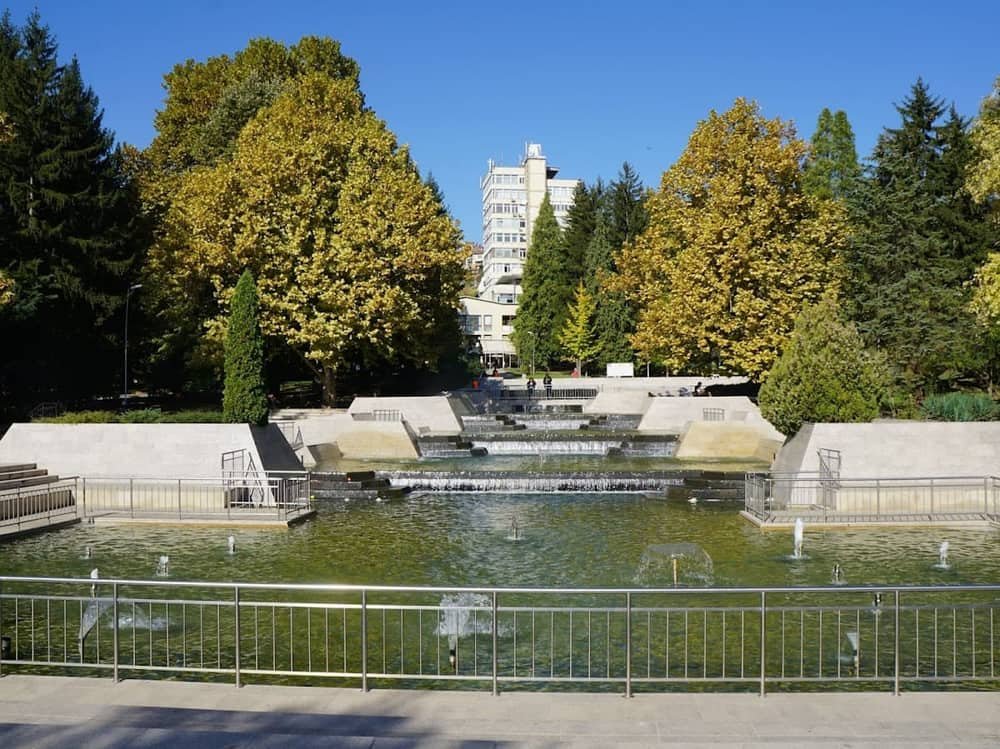
At the southern end of Vitosha Boulevard, beyond a broad plaza of fountains and lawns, rises NDK (Natsionalen Dvorets na Kulturata) — the largest congress and culture centre in south-eastern Europe, a monumental 1980s construction. You come not so much for the interior architecture as for the park in front, the Sofians' favourite spot for strolling, skating and watching the sun go down, with the mountain as backdrop.
And the rest of the centre
Sofia's centre is comfortably walkable and packs, within a few hundred metres, a rare density of layered history:
- The Sveti Georgi Rotunda — the oldest building in the city, a fourth-century Roman brick rotunda hidden in a courtyard beside the presidency; it holds medieval frescoes painted in successive layers.
- The Banya Bashi Mosque, the Sephardic synagogue (one of Europe's largest) and the cathedral — all within a short walk of one another, the emblem of Sofia's "tolerance."
- The little Russian church of Sveti Nikolai, with its fairy-tale gilded onion domes.
- The Central Mineral Baths (Tsentralna Banya), the former public bathhouse, now the city museum, beside the mineral springs where locals still fill their bottles.
- Independence Square (the Largo) and the Stalinist-era state buildings, plus the Ivan Vazov National Theatre with its neoclassical façade, behind a quiet square.
Neighbourhoods to explore
Beyond the monumental core, Sofia has neighbourhoods with character that reward an hour or two of aimless wandering:
- The old centre and gallery quarter — around Graf Ignatiev and Shishman streets runs a web of plane-shaded lanes, second-hand bookshops, specialty cafés and small galleries. The city's quietly bohemian corner.
- Oborishte / the Doctor's Garden — belle-époque buildings, embassies, a leafy park with its stone monument; calm and elegant.
- The Vitoshka and southern area — commercial, lively, full of terraces.
- Studentski Grad — the student campus, epicentre of cheap and noisy nightlife.
- The Women's Market (Zhenski Pazar) — the traditional market, colourful and authentic, where the air smells of spices, cheese and tomatoes.
Day trips
Boyana Church + Mount Vitosha
At the foot of the mountain, in the Boyana district, a UNESCO-listed jewel awaits: Boyana Church, a modest little medieval chapel on the outside that preserves a layer of frescoes from 1259, reckoned among the most important in pre-Renaissance European art — faces of an astonishingly individualised expressiveness. Visitors enter in small groups for only a few minutes, to protect the paintings; it is worth booking ahead.
From here it is a short hop to Mount Vitosha, Sofia's backdrop and its natural playground. In summer you hike marked trails, climb toward the Cherni Vrah summit (over 2,200 m) or wander among the "stone rivers" (boulder moraines). In winter, Vitosha has modest ski slopes barely half an hour from the centre — almost unique in Europe: a capital with skiing on its doorstep. Check whether the cable car is running before you go (it has been closed for long stretches) and bring warm layers: on the ridge the weather plays by different rules than in town.
Rila Monastery
If you make only one trip out of Sofia, make it this one. Rila Monastery, nestled above 1,100 m in the heart of the Rila mountains, some 120 km south of the capital, is Bulgaria's foremost spiritual monument and a UNESCO site. The inner courtyard leaves you speechless: arcades painted in black-white-red stripes, a medieval stone tower (Hrelyu's Tower) and the Church of the Nativity, covered floor to dome in vividly coloured frescoes. Founded in the tenth century by the hermit John of Rila, the monastery was for centuries the heart of Bulgarian identity under Ottoman rule.
Go by car (roughly a two-hour drive, unhurried, on mountain road) or on an organised day tour from Sofia — often combined with the nearby Rila rock church or a neighbouring monastery. Bring something warm even in summer: at that altitude the air bites. And don't leave without trying, at the kiosk by the gate, the famous warm doughnuts (mekitsi) and the bread baked by the monks. For those with time and good legs, the same Rila massif is the gateway to the Seven Rila Lakes, another wonder — but that one needs a separate day.
Where to stay
For a city break, the centre is the obvious choice: staying within the triangle of Vitosha Boulevard, Nevsky Cathedral and NDK puts everything at your feet and frees you from transport. Sofia offers, at prices generally gentler than in Western European capitals (indicative, check when booking), everything from boutique hotels in period buildings to modern guesthouses and apartments. Those wanting quiet and greenery can choose the Doctor's Garden / Oborishte area; those wanting nightlife at the door, the Vitoshka perimeter. For hiking on Vitosha there are also stays at the mountain's foot, in Boyana or Dragalevtsi, but for a city stay keep to the centre.
Food and nightlife
Bulgarian cooking is Mediterranean-Balkan, generous and friendly to grilled meat and vegetables:
- Shopska salad — the national salad: tomatoes, cucumbers, peppers and salty cheese grated on top like snow over a hill.
- Banitsa — a flaky filo pastry filled with cheese, the classic breakfast, paired with a glass of boza or drinking yoghurt (ayran).
- Kavarma, kebapche, kyufte — clay-pot stews and grilled mince rolls and patties, the soul of any menu.
- Genuine thick Bulgarian yoghurt and sheep's cheeses.
- For dessert, baklava and syrup-soaked cakes of Ottoman lineage.
Sofia drinks well and cheaply: Bulgarian wines (especially the reds from the native mavrud or melnik grapes of the south) are underrated and very enjoyable, while plum or grape rakia opens any serious meal. For a night out, the Vitoshka area and surrounding streets concentrate bars, terraces and restaurants; the student quarter Studentski Grad is cheaper and louder; and the hidden bars in the courtyards of the old centre are the city's most pleasant secret.
Getting around
Sofia's centre is for walking — most sights are 10-15 minutes apart. For longer distances:
- The metro is clean, fast and cheap, with two main lines linking the airport, the centre (the Serdika station) and the large neighbourhoods. It is the simplest way in from the airport.
- Trams and trolleybuses cover the city densely; tickets come from machines or by tapping a contactless card straight at the validator.
- Taxis are inexpensive, but only take marked cars with the meter running; ride-hailing apps work here too.
- From the airport: the metro reaches the centre in about 20-30 minutes (indicative), far more comfortable than a taxi in traffic.
If you arrive by car from Romania: there is no longer a border check (Schengen), but remember two things. First, you must have an electronic vignette to drive on Bulgarian roads — buy it online or at a petrol station before you join the motorway, or you risk a fine. Second, fuel costs around 2 euro per litre (petrol and diesel, indicative). In town, central parking is paid by zone (blue/green) — simpler to leave the car at the hotel and switch to metro and feet.
A suggested itinerary
Day 1 — the heart of the city. Begin at Alexander Nevsky Cathedral in the morning, when the light falls on the domes, then cross to St Sofia and descend into its necropolis. Carry on to the Sveti Georgi Rotunda, the Roman ruins of Serdica and the Largo square. In the afternoon, an easy stroll down Vitosha Boulevard to NDK, with a coffee en route. In the evening, dinner and a glass of mavrud in the Vitoshka area.
Day 2 — Boyana and Vitosha. In the morning, Boyana Church with its frescoes of 1259. From there climb Mount Vitosha — an easy hike in summer, snow in winter — and lunch at a mountain lodge. Back to town in the afternoon, with time for the Zhenski Pazar market or the gallery quarter and some shopping along Vitoshka. In the evening, hidden bars in the old centre's courtyards.
Day 3 (optional) — Rila Monastery. A full day given to Bulgaria's most beautiful site: the mountain road to Rila, the courtyard of painted arcades, the fresco-filled church, the warm doughnuts at the gate. Back to Sofia in the evening, tired and content. If you have only two days, sacrifice the third — but put Rila on the list for your next visit.
Sofia is in no hurry to impress you, and that is exactly why it lingers. You leave with the rare sense of a city that already belongs to you a little — its mountain always on the horizon, its history underfoot.
FAQ
Do I need a passport to travel from Romania to Bulgaria? No. Romania and Bulgaria are both in the Schengen area, so there is no longer any passport or ID check at the Danube land border — you cross as if between two counties. As of 2026 Bulgaria's currency is also the euro, though the lev still circulates in parallel during the transition.
How long do I need for a city break in Sofia? The guide lays out a classic two-to-three-day stay: day one for the heart of the city (Alexander Nevsky, St Sofia, the Serdica ruins, Vitosha Boulevard), day two for Boyana and Mount Vitosha, and an optional third day for Rila Monastery.
What is the best day trip from Sofia? Rila Monastery, a UNESCO site some 120 km south of the capital at over 1,100 m altitude. If you make only one trip out of Sofia, this is the one; the drive takes roughly two hours (indicative) on mountain road.
How do I get from the airport to central Sofia? The metro is the easiest way, linking the airport directly to the centre (Serdika station) in about 20-30 minutes (indicative) — far more comfortable than a taxi in traffic. The metro is clean, fast and cheap.