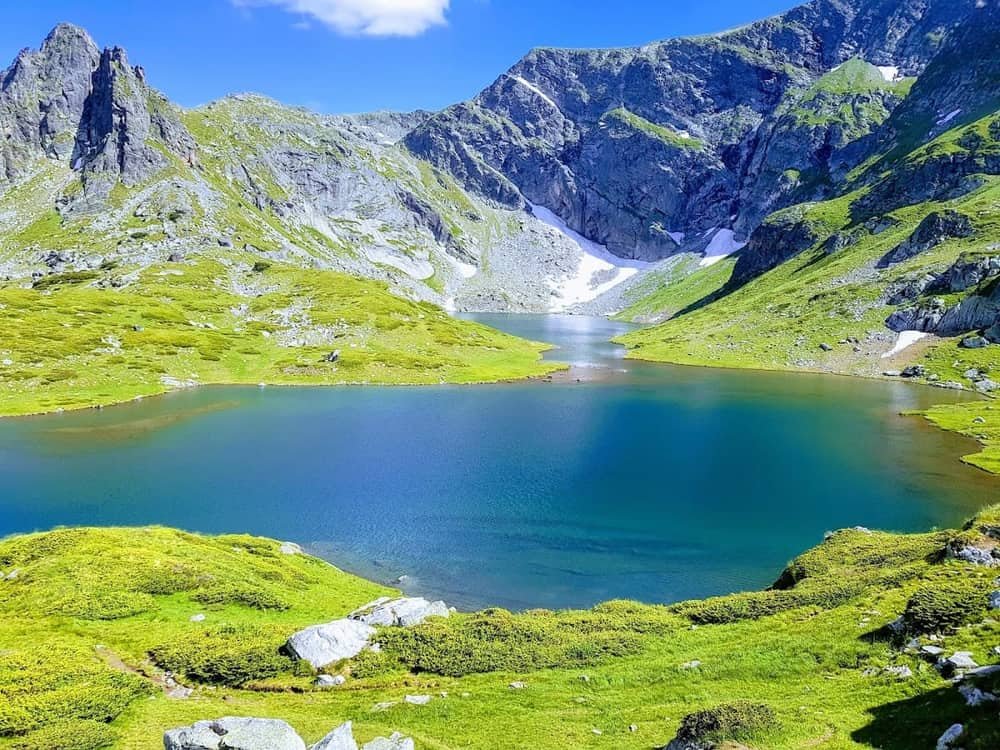
The Bulgaria most foreign visitors know stops at the waterline — Sunny Beach, Nessebar, Albena, Sveti Vlas. Yet just a few hours inland a different country begins: one of granite ridges above 2,900 metres, heart-shaped glacial lakes, and forests where the brown bear still leaves real tracks. Bulgaria holds three national parks and eleven nature parks, and two of its treasures — Pirin and its glacial legacy — carry UNESCO World Heritage status. This guide shows you how to read these mountains, how to walk them, and above all how to treat them.
The three national parks
In Bulgarian terms, the distinction matters. A national park (Rila, Pirin, Central Balkan) protects near-pristine ecosystems, with strict reserve zones closed to all access. A nature park (Vitosha, Strandzha, Belasitsa and others) allows more human activity — villages, traditional grazing, tourism — within ecological limits. Both reward a visit; only the rules differ.
Rila National Park
Rila is the roof of the Balkans. It holds Mount Musala (2,925 m), the highest point on the entire Balkan Peninsula, and gives rise to the Iskar river that carves through Sofia. The park protects more than 800 square kilometres of ridges, glacial cirques and around 120 alpine lakes.
The star draw remains the Seven Rila Lakes (Sedemte Rilski Ezera), a string of glacial mirrors terraced between roughly 2,100 and 2,500 metres, each with its own descriptive name — the Tear, the Eye, the Kidney, the Twin, the Trefoil. A chairlift from the Panichishte side shortens the climb, but the full loop linking all seven asks for a whole day and legs used to altitude. The view from the upper ridge, every lake lined up below, is among the most photographed images of Bulgaria — and earns its reputation.
On the park's edge, though technically outside it, stands Rila Monastery, the country's foremost spiritual monument and a UNESCO site. A natural pairing: a day of hiking, a day of culture.
Pirin National Park (UNESCO)
If Rila is majestic, Pirin is dramatic. The marble-and-granite massif above the town of Bansko was inscribed on the UNESCO World Heritage list back in 1983 for its exceptional glacial relief and its pine forests, which shelter the Baikushev pine — a Bosnian pine estimated at over 1,300 years old, one of Europe's oldest living trees.
Pirin counts more than 70 glacial lakes, clustered into spectacular chains — the Banderishka, Vasilashka and Popovo lakes. Vihren (2,914 m), Bulgaria's second-highest peak, is a serious ascent, with exposed ridge sections that do not forgive bad weather. In winter Bansko becomes the largest ski resort in the Balkans; in summer the same gondola gives you a generous head start toward the alpine zone.
Pirin proves a truth about Bulgaria's mountains: the south is warmer, more Mediterranean. Not far away, in Melnik, the country's smallest town, sand pyramids and dense red wine already tell a different story from the frozen ridges above.
Central Balkan National Park
Strung along the main ridge of the Stara Planina — the range that crosses Bulgaria from west to east — Central Balkan protects some of Europe's oldest beech forests, several of them separately inscribed by UNESCO as primeval woodland.
Here nature works vertically. Raysko Praskalo (\"Heaven's Splash\"), with a drop of roughly 124 metres, is the highest waterfall in the Balkans. Below Mount Botev (2,376 m), the tallest in the Stara Planina, alpine meadows shelter chamois, while the forests beneath hold genuine populations of brown bear, wolf, and the griffon vulture that has been painstakingly reintroduced in recent years. The Troyan monastery and the nearness of Veliko Tarnovo make this a natural gateway from the country's north.
The nature parks: wilderness within reach
Vitosha
Vitosha is a rare urban luxury: an entire massif, topped by Cherni Vrah (2,290 m), on the doorstep of the capital, Sofia. The first nature park in the Balkans (1934), it is the city's lungs and playground. Its geological signature is the \"stone rivers\" — long tongues of granite boulders left by ice ages, with water running unseen beneath. Reachable by city transport, it is ideal for a first acclimatisation day.
Strandzha
At the opposite end, deep in the southeast near the coast and the Turkish border, Strandzha is Bulgaria's largest nature park. Its damp, sub-tropical relict forests shelter species that survived the ice ages. For beach visitors out of Burgas or Sozopol, it is a green escape less than an hour from the crowded sands, with villages that still keep the fire-walking ritual (nestinarstvo) and an almost forgotten quiet.
Wildlife and flora: what you will actually see
Bulgaria's mountains host one of Europe's healthiest brown bear populations (indicative figures: in the hundreds), alongside wolf, chamois, wildcat and Eurasian lynx. Do not expect to see a bear — and that is the point; the mark of a healthy population is that the animals avoid people. What you will see instead are marmots whistling across the slopes, eagles riding the thermals, and, in spring, carpets of mountain peony and gentian.
In flora, Rila and Pirin guard rare endemics such as the Rila primrose (rilska iglika), which grows nowhere else on Earth. That is why the rule \"pick nothing\" is not bureaucratic pedantry but the protection of unique species.
Visitor rules and responsible travel
Bulgaria's national parks are free to enter, but not free of rules. You keep them not out of obligation but because you care about the place you came to see.
- Stay on the trails. Waymarks are painted on rocks and trees, in coloured triangles and bands. Shortcuts erode alpine soil that recovers over decades, not years.
- Do not camp or light fires outside designated areas. In national parks, wild camping and fires are generally forbidden; mountain huts (hizha) provide shelter.
- Pick no plants, disturb no animals, leave no trace. Whatever you carry in, you carry out — fruit peels included; they are not \"natural\" at 2,500 metres.
- Keep dogs leashed; there are flocks and guardian dogs (karakachan) that take their job seriously.
- Check the weather. The Rila and Pirin ridges change face in minutes; afternoon storms are the summer rule, not the exception. Start early.
- Equip properly: layers, a rain shell, water, an offline map. Phone signal vanishes fast.
Getting there and what to know now
Good news for the regional traveller: Romania and Bulgaria are now both in Schengen, so the land border has no passport or ID control — you cross as if between provinces. To drive, you need a mandatory electronic vignette, bought online or at filling stations before you use the main roads. Fuel runs around 2 euro per litre (petrol and diesel, indicative).
Bulgaria has switched to the euro, though the lev still circulates in parallel during the transition — you will see both prices displayed for a while. For mountain huts and the lifts at Bansko, Borovets or Panichishte, always carry some cash; not every point takes cards.
Logical bases: Bansko for Pirin, the Borovets / Panichishte area for Rila, Troyan or Veliko Tarnovo for Central Balkan, Sofia for Vitosha, and Burgas or Sozopol for Strandzha. Many of these routes pair elegantly with a stay on the coast or a city break in Plovdiv — Bulgaria is more compact than the map suggests.
These mountains do not ask you to be a mountaineer. They ask only that you come prepared, walk slowly, and leave the place exactly as you found it. That is the only way it will still be there for those who come after you.
FAQ
How many national parks does Bulgaria have, and which are they? Bulgaria has three national parks — Rila, Pirin and Central Balkan — plus eleven nature parks. A national park has more restricted access, with strict reserve zones closed to all entry, while nature parks (Vitosha, Strandzha and others) allow more human activity within ecological limits.
What is the highest peak, and where is it? Mount Musala (2,925 m), in Rila National Park, is the highest point on the entire Balkan Peninsula. The second, Vihren (2,914 m), stands in Pirin and is a serious ascent, with exposed ridge sections that do not forgive bad weather.
Do I have to pay to enter the national parks? No, Bulgaria's national parks are free to enter, but they come with firm rules: stay on the trails, do not camp or light fires outside designated areas, pick no plants and disturb no animals. Keep dogs leashed, and whatever you carry in, you carry out.
What should I know about the Seven Rila Lakes? They are a string of glacial lakes terraced between roughly 2,100 and 2,500 metres, each with its own descriptive name — the Tear, the Eye, the Kidney, the Twin, the Trefoil. A chairlift from the Panichishte side shortens the climb, but the full loop linking all seven asks for a whole day and legs used to altitude.