Bulgaria is far more than a coastline of beaches and resorts. A few hours inland from the Black Sea, the land rises into limestone massifs cut through by rivers, and water has carved one of south-eastern Europe's most spectacular underground worlds. Waterfalls tumbling over terraced travertine, caves with kilometres of galleries, and an opening in the rock that locals call the "Eyes of God" — all of it fits into a road trip of a few days, on good roads and with no fuss at the border.
This guide gathers Bulgaria's finest waterfalls and caves, with what to expect at each, how to get there, and what's worth knowing before you set off. Our tone is honest: we flag as indicative any hours, prices or figures that shift from season to season, because they genuinely vary and we don't want you travelling on false certainty.
Before you go: what changed at the border and on the road
Good news for travellers from Romania. Romania and Bulgaria are now both in the Schengen area, so crossing the Danube by land means no passport or ID checks — you pass almost as if moving between two counties, though it's still wise to carry your document for random spot checks.
- The currency is now the euro. Bulgaria has adopted the euro, with the lev still circulating in parallel during the transition. You can pay by card almost everywhere, but it helps to carry some cash for entry fees at smaller caves or for mountain car parks.
- An electronic vignette is mandatory on Bulgarian roads. Buy it online or at a fuel station before joining the main network; your plate is registered electronically, so there's no physical sticker. Driving without one risks a fine.
- Fuel costs around 2 euro per litre (petrol and diesel, an indicative figure). Distances between sites are short, but mountain roads eat time.
Most of the sites in this guide lie in northern and north-western Bulgaria, quickly reached via the Calafat–Vidin and Giurgiu–Ruse bridges.
The waterfalls
Krushuna Falls — Bulgaria's turquoise water
If one image has travelled the world, it's this one: a cascade stepping down over moss-cloaked travertine rock, forming pools of an almost unreal green-turquoise. Krushuna Falls, beside the village of the same name in the Lovech region, are the largest travertine waterfall in Bulgaria and the most photogenic stretch of water in the country.
- What to expect: a managed path climbs alongside the falls, with wooden boardwalks and steps. From below you get the best view of the turquoise pools; from the top you reach the spring that feeds the whole system. The colour comes from dissolved calcium carbonate and is most intense in soft, diffused light.
- Access: a good road to the village, parking at the base, then on foot. The main trail is short and accessible, but the steps can be slippery after rain — wear shoes with grip.
- Tips: come early or toward evening to dodge weekend crowds and catch gentle light. Pair it with Devetashka Cave nearby — together they make a perfect day.
Rayskoto Praskalo — the tallest waterfall in the Balkans
High in the heart of the Balkan Mountains (Stara Planina), below Botev Peak, the range's highest summit, Rayskoto Praskalo — the "Heavenly Spray" — plunges down. With a drop of roughly 120 metres (an indicative figure, variously reported), it's considered the tallest permanent waterfall in Bulgaria and the Balkans.
- What to expect: a thin, dizzying white ribbon that breaks into mist against the rock face. Flow peaks in spring with the snowmelt; by high summer it can thin considerably.
- Access: this is not a drive-up sight. You reach it on a marked mountain trail, usually from the Rai hut, after a serious climb. It's a hike for the fit, with proper kit and time in reserve.
- Tips: check the weather and trail conditions first; this is alpine terrain that changes fast. For those less inclined to the effort, the view from the hut is reward enough.
Boyana Waterfall — nature on Sofia's doorstep
At the foot of Vitosha Mountain, right on the edge of the capital Sofia, the Boyana Waterfall (Boyanski vodopad) drops nearly 15 metres (an indicative figure) through a forest setting. It's proof you don't have to travel far from the city for a dose of wild nature.
- What to expect: a slender fall in a quiet woodland frame, at its best in spring and after rain. In winter it sometimes partly freezes, for a striking sight.
- Access: set off from the Boyana district on a path climbing through forest; a few stretches are steeper. Near the start stands the famous Boyana Church, a UNESCO site, so you can combine the two.
- Tips: good footwear and water with you. It's the ideal choice if you have half a day in Sofia and want to escape the tarmac.
The caves
Devetashka Cave — the underground cathedral with windows of light
Few places in Bulgaria are as breathtaking as Devetashka. A vast gallery, its ceiling pierced by natural openings through which light descends in columns, over a river winding along the cave floor. It served as a film set and has been inhabited since prehistory.
- What to expect: a monumental hall, reached on walkways, with those "windows" of light that lend an almost sacred atmosphere. The Osam River passes by the entrance.
- Access: a road runs almost to the entrance, near the village of Devetaki in the Lovech region. The interior visit is partly along managed paths.
- Tips: part of the cave closes seasonally to protect the bat colonies that live here — check the schedule first (indicative, it varies). Diffused light and silence: give yourself time to sit and look.
Prohodna — the "Eyes of God"
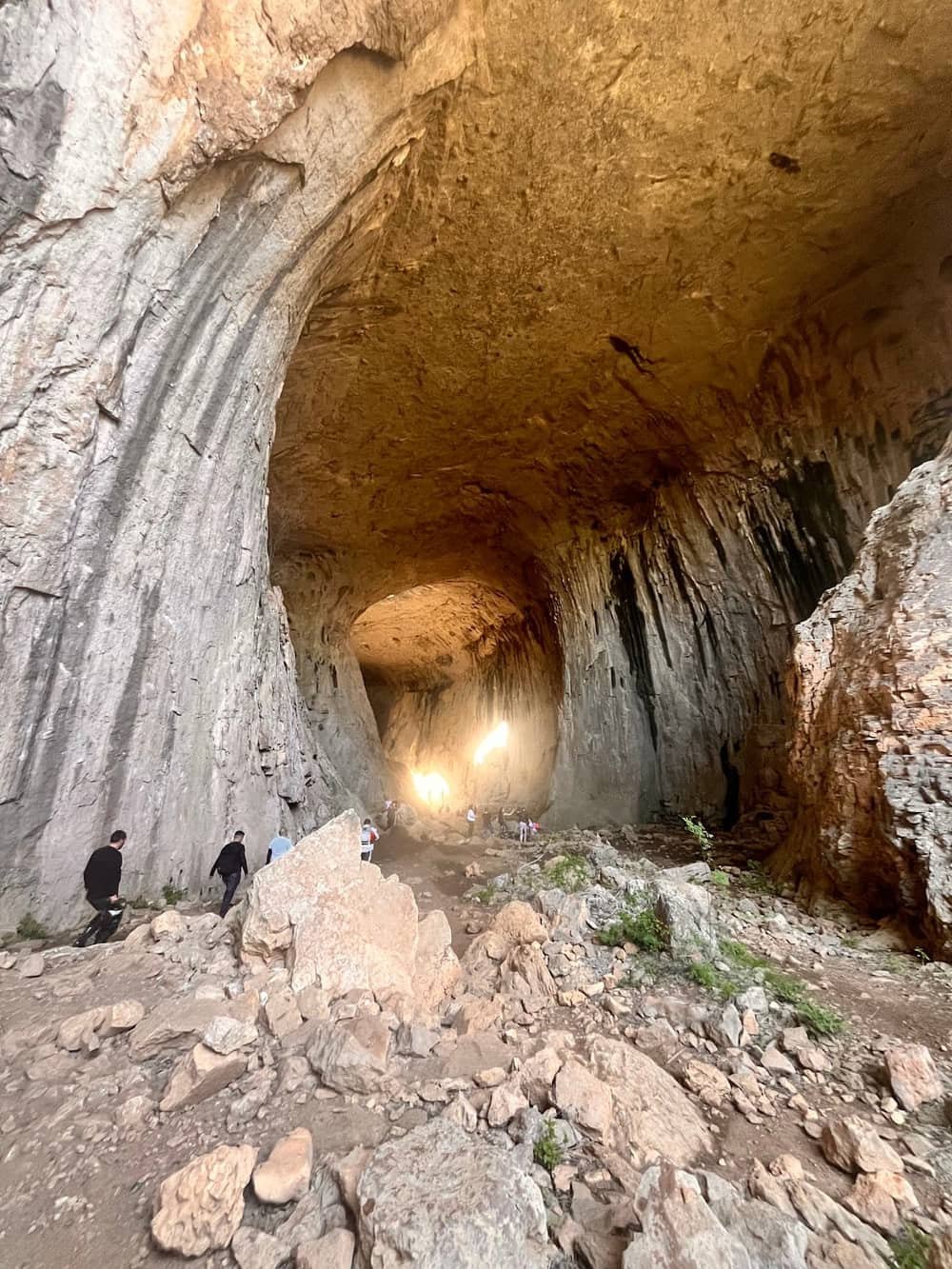
Near the village of Karlukovo lies perhaps Bulgaria's most viral cave. Prohodna is a rock tunnel you walk straight through, and in its ceiling sit two oval openings, perfectly symmetrical, which from below look like a pair of eyes gazing down from the sky. Hence the name: the "Eyes of God".
- What to expect: a short, striking passage, with the two "eyes" shifting expression by the light — they "weep" when it rains, water trickling from them. The site is also a known spot for climbing and bungee jumping.
- Access: free entry, no ticket, on a short path from the Karlukovo area. It's one of the most accessible experiences in this guide.
- Tips: come around midday, when the sun falls through the openings and the "eyes" effect is at its strongest. Combine it with the surrounding karst country, full of rock and trails.
Magura — the cave with prehistoric paintings
In the far north-west, near Belogradchik and its red rocks, Magura hides something no other cave on this list has: prehistoric rock paintings, made with bat guano and thousands of years old — figures of people, animals and signs that appear to be a calendar.
- What to expect: broad galleries with large formations, halls still used today to age a sparkling wine produced inside the cave itself, plus the famous protected paintings.
- Access: drive almost to the entrance, in the Rabisha area. Visits are usually guided.
- Tips: tie Magura to Belogradchik — its fortress and rock formations are among the most spectacular views in Bulgaria. A day in the north-west gives you nature, history and wine.
Snezhanka — the jewel of the Rhodopes
Near Peshtera, in the Rhodope Mountains, close to the Pamporovo ski area, Snezhanka ("Snow White") is small but astonishingly rich in formations. It's one of Bulgaria's most beautifully decorated caves.
- What to expect: stalactites, stalagmites and fine draperies, among them a formation nicknamed "Snow White" herself. The guided tour is short but dense.
- Access: drive to the car park, then a path climbs to the entrance. Visits are guided only, in groups, at set times (indicative).
- Tips: ideal to combine with a mountain day in the Rhodopes or with Pamporovo. The cave stays cool year-round — bring a jacket.
Ledenika — ice in the Balkan Mountains
Above the town of Vratsa, Ledenika earns its name: in winter and spring, ice stalactites and columns form in the first chamber, hence its reputation as the "ice cave". It's one of the most visited caves in Bulgaria.
- What to expect: a route through several halls, varied formations and a small underground lake; a narrow passage tellingly called "the sins". The acoustics of some halls are remarkable.
- Access: a mountain road from Vratsa to the cave, through the spectacular Vratsata gorge. Visits are guided.
- Tips: the ice is most impressive in late winter to early spring. The access road can be difficult under snow — check its condition.
Stitching it into a route
Geography is on your side. Most sites group naturally:
- North-central (Lovech): Krushuna + Devetashka, easily done together in a day, with Veliko Tarnovo and Tsarevets nearby for the evening.
- North-west (Vratsa–Belogradchik): Ledenika, the "Eyes of God" at Prohodna near Karlukovo, then Magura and Belogradchik — a route of raw nature and history.
- South, the Rhodopes: Snezhanka, perfect alongside Pamporovo, Plovdiv and Bachkovo Monastery.
- Near Sofia: the Boyana Waterfall and Boyana Church, for half a day.
Practical tips, in brief
- Kit: shoes with grip, a jacket even in summer (caves are cold and damp), a backup torch.
- Season: waterfalls peak in spring with the snowmelt; ice caves in late winter. Check the seasonal schedule — many caves close partly for bats or run on set hours (indicative).
- Respect: don't touch the formations (skin oils stop their growth), don't disturb the bats, leave no litter. The underground world grows by millimetres per century.
- Documents and money: card almost everywhere, some euro cash for small fees; vignette activated before you drive.
Bulgaria's underground rewards curiosity. With a border free of barriers and short hops between sites, you can go from the turquoise waters of Krushuna to the stone eyes of Prohodna in a single day — and come home feeling you've seen a country too few people think to look beneath.
FAQ
What is Bulgaria's most spectacular waterfall? Krushuna Falls, beside the village of the same name in the Lovech region, are the country's largest travertine waterfall, with green-turquoise pools. The colour comes from dissolved calcium carbonate and is most intense in soft light; pair the visit with nearby Devetashka Cave.
What is Prohodna cave and why is it called the "Eyes of God"? Prohodna, near Karlukovo, is a rock tunnel with two symmetrical oval openings in its ceiling that, seen from below, look like a pair of eyes gazing from the sky. Entry is free with no ticket; come around midday, when the sun falls through the openings and the effect peaks.
Which caves have seasonal restrictions? Part of Devetashka closes seasonally to protect its bat colonies, while Snezhanka and Ledenika are guided-only, at set times (indicative, it varies). Check the schedule beforehand, as hours and access change from season to season.
How do I reach these sites from Romania? Most falls and caves lie in northern and north-western Bulgaria, quickly reached via the Calafat–Vidin and Giurgiu–Ruse bridges. You need an electronic vignette, and fuel costs around 2 euro per litre (indicative).