Bulgaria in Winter, Beyond the Slopes
For most visitors, winter in Bulgaria comes down to one word: Bansko. That is fair enough — the runs in the Pirin mountains are among the best in the Balkans, and prices stay, year after year, gentler than in the Alps. But reducing a Bulgarian winter to drag lifts and gondolas means missing the part that actually lingers in memory: old towns under frost, thermal baths steaming into freezing air, silent monasteries in the mountains, and a masked carnival that was never designed for tourists. This is the guide to the other Bulgarian winter — the one where you never lace up a ski boot.
Good news for anyone crossing over: the border is no longer an obstacle. Romania and Bulgaria are both inside the Schengen area, which means there is no passport or ID check at the land border — you cross as if moving between two counties. The official currency is now the euro, although the lev still circulates in parallel during the transition; double-check your change and read prices carefully where both currencies are displayed.
Winter cities and Christmas markets
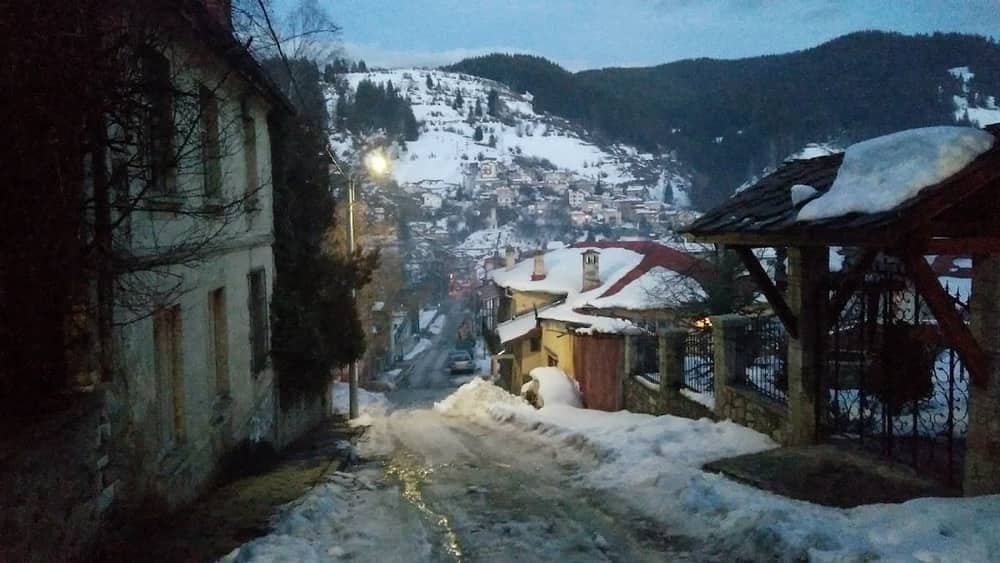
Winter brings out the most intimate side of Bulgaria's towns. The coastal queues are gone, hotels are half empty, and the historic cores breathe differently under snow.
- Plovdiv is the number-one choice for a cold-weather city break. Its Old Town, a cluster of Bulgarian National Revival houses spilling over three hills, looks magnificent in snow, while the pedestrian spine of Knyaz Aleksandar I fills with lights and the smell of mulled wine. This is a city made for walking, from the Roman theatre down to bohemian Kapana with its tiny cafés.
- Sofia works beautifully as a weekend escape: the Aleksandar Nevski cathedral under falling snow, the German-inflected Christmas market by the National Theatre with its crafts and food, and the bonus that Mount Vitosha sits just half an hour from the centre if you do start craving serious snow.
- Veliko Tarnovo, the old medieval capital, may be the country's most photogenic winter town. Houses cling to steep slopes above the Yantra river, and above them all stands the Tsarevets fortress, which in winter draws far fewer visitors and lets itself be explored in peace.
- Varna and Burgas, the big coastal cities, do not shut down when the beach season ends. The off-season seafront has its own melancholy charm: the empty promenade in Varna, the grey and restless Black Sea, warm cafés, and prices stripped of the summer premium. Neighbouring resorts — Sunny Beach, Golden Sands, Albena, Sveti Vlas — mostly slumber, but the island-town of Nessebar, on its spit of land in the sea, is genuinely magical when empty and frozen.
Indicative note: Bulgaria's Christmas markets usually open in late November and run past New Year, but exact dates shift from year to year — check before you travel.
Spas and thermal waters
Few people realise that Bulgaria sits on one of Europe's richest reserves of geothermal water — over a hundred resorts fed by mineral springs, many used since Roman and Thracian times. Winter is exactly the season they were made for.
- Pomorie, on the coast near Burgas, is famous for its therapeutic mud (lia) and its salt lake. It runs year-round, and in winter you can pair a warm mud treatment with a walk along a completely deserted beach.
- Velingrad, in the Rhodope mountains, is regarded as the "spa capital of the Balkans" — dozens of hot springs and a deeply rooted bathing culture. It is the ideal destination if you simply want three or four days of hot pools and nothing else on the schedule.
- Hisarya, near Plovdiv, is a spa town with Roman walls still standing, while Sandanski, in the south-west, has a reputation for a mild climate and air that is kind to the lungs.
The defining image of a Bulgarian winter spa is the open-air pool at forty degrees, steam rising off the surface while snowflakes drift down around you. Many hotels in Bansko and at Borovets also have generous wellness areas — worth knowing if you are travelling with someone who skis while you do not.
Monasteries in the snow
No serious winter guide can skip the monasteries. In summer they are choked with coaches; in winter they become what they have always been — places of silence.
- Rila Monastery, tucked into a valley of the mountains that share its name, is the most important in Bulgaria and a UNESCO World Heritage Site. Under snow, the black-and-white stripes of its arcades and the exuberant frescoes of the main church take on an almost unreal intensity. The access road is usually cleared, but check conditions in heavy weather.
- Bachkovo Monastery, the second most important, is closer to Plovdiv and easy to fold into a day trip. It is renowned for the frescoes at its entrance and for an atmosphere of genuine pilgrimage.
- Troyan Monastery, in the Central Balkans, comes with another reason to climb up there in winter: the town of Troyan and the nearby village of Oreshak are the heartland of Bulgarian ceramics and plum rakia.
One matter of basic respect: these are active places of worship. Keep to a modest dress code, speak quietly, and ask before photographing inside the churches.
Kukeri and Surva — the carnival of masks
If there is a single reason to plan your Bulgarian winter around a specific date, it is Kukeri. This is one of Europe's oldest and most powerful rituals: men — and, increasingly, women — clad in heavy fur costumes, wearing carved, nightmarish masks and tens of kilos of copper bells at the waist, dance with deliberate, pounding steps to drive off evil spirits and summon a fruitful year. The low roar of the bells, audible long before you see the procession, is unforgettable.
The largest gathering is the Surva festival in Pernik, near Sofia, which draws hundreds of troupes from across the country and the wider Balkans — typically in late January, though you should confirm the exact edition dates. There are also countless smaller ceremonies in villages around New Year and the start of Lent, often more authentic precisely because they are not staged for an audience. If you happen upon one, keep your distance from the dancers — the bells and staves are heavy and serious — and let locals hold the front row.
The mehana — warmth at the table
A Bulgarian winter is ultimately lived at the table. The mehana is the traditional tavern — timber, woven cloths, a fire in the hearth — and it is the institution where the cold outside melts away.
- Start with a rakia (plum or grape), sipped slowly, alongside a shopska or a warm winter salad.
- Order the slow-cooked, clay-baked dishes: kavarma (stew), gyuvech, bob chorba bean soup, stuffed peppers, and in Bansko kapama — a layered dish baked for hours, a signature of the Pirin winter.
- Bulgarian cheeses — sirene (a brined white cheese) and kashkaval — turn up everywhere, and a warm slice of banitsa, the cheese-filled pastry, is the perfect breakfast on a frozen morning.
In towns like Bansko the mehana is as much a part of the experience as the slope; look for the places packed with locals, not the ones with menus translated into five languages.
Logistics in brief
- Driving in: you enter from Romania with no border check. Bulgarian roads require a mandatory electronic vignette — buy it online or at a petrol station before joining the main roads; there is no physical sticker on the windscreen. Fuel costs around 2 euro per litre (petrol and diesel, indicative).
- Winter on the roads: winter tyres and chains are essential on the mountain routes to Bansko, Borovets, Pamporovo or Rila. Passes can close in heavy snow.
- Money: the currency is now the euro; the lev still circulates during the transition. Cards work almost everywhere in the cities, but keep some cash for small mehanas, monasteries and markets.
- When to go: December for markets and atmosphere, January for serious snow and for Kukeri, February for spas and total quiet.
A ski-free Bulgarian winter is no consolation prize — it is an older, warmer, more honest country than the one on the summer coast. And the best time to see it is precisely when everyone else assumes it has closed until spring.
FAQ
What can you do in Bulgaria in winter besides skiing? Plenty: cold-weather city breaks in Plovdiv, Sofia or Veliko Tarnovo, with Christmas markets; spas and thermal waters at Velingrad, Devin, Hisarya or Pomorie; silent monasteries under snow; and the masked carnival of Kukeri. It is a more intimate Bulgaria, the one where you never lace up a ski boot.
What are Kukeri and the Surva festival? Kukeri is one of Europe's oldest rituals: men — and, increasingly, women — in heavy fur costumes, carved masks and tens of kilos of copper bells at the waist, dancing to drive off evil spirits. The largest gathering is the Surva festival in Pernik, typically in late January — confirm the exact edition dates.
Which cities are worth visiting in winter? Plovdiv is the number-one choice for a cold city break, its Old Town magnificent in snow; Sofia has a Christmas market and Mount Vitosha just half an hour away; Veliko Tarnovo, the old medieval capital, may be the most photogenic; and on the coast, an empty, frozen Nessebar is magical.
What do I need for winter driving? You enter from Romania with no border check (Schengen), but Bulgarian roads require a mandatory electronic vignette. Winter tyres and chains are essential on the mountain routes to Bansko, Borovets or Rila, and passes can close in heavy snow. Fuel costs around 2 euro per litre (indicative) — see fuel.