Bulgaria's Black Sea coast runs for roughly 380 kilometres, from the Romanian border in the north to the Turkish border in the south. It is, without exaggeration, one of the most welcoming and most accessible coastlines in Europe — and, for anyone arriving from Romania, it has just become dramatically easier to reach than it was only a few years ago.
The character of the coast
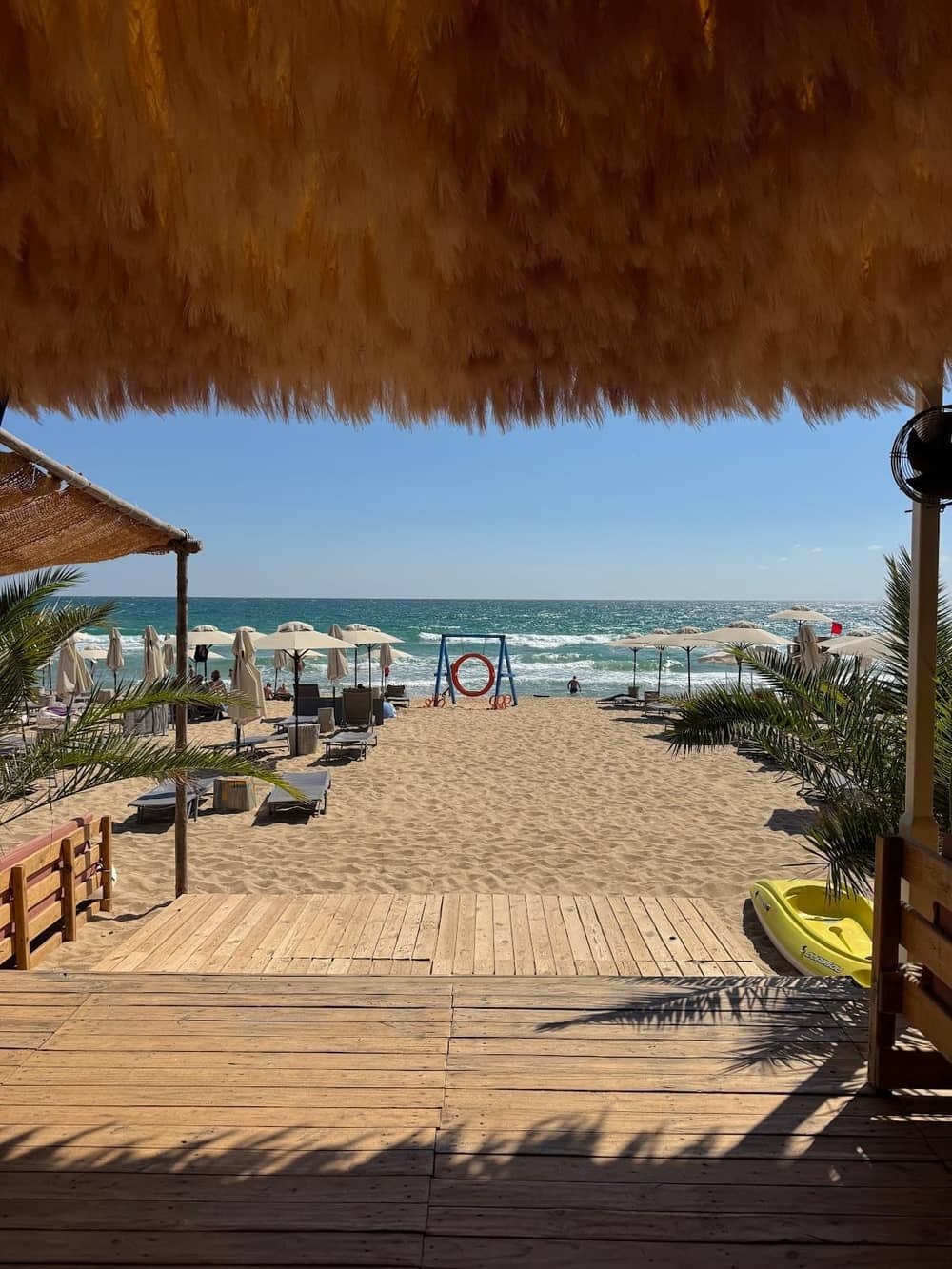
The first thing that strikes you, on almost any of the big beaches, is the sand: fine, pale, often golden, spread in broad ribbons that leave room to walk, to play and to lay out a towel without a stranger's elbow in your ribs. Unlike many Mediterranean beaches with their shingle or their abrupt drop-offs, the Bulgarian coast generally offers a gentle, gradual entry into the water. The sea stays shallow for a good distance from the shore, the bottom is sandy, and the waves are usually mild.
This is exactly why the Bulgarian coast is, far and away, ideal for families with young children. Little ones can paddle in safety, the water warms quickly through the summer, and the depth increases so gradually you barely notice it. The season proper runs from June to September, peaking in July and August when the sea reaches its most inviting temperatures; May and September are quieter and often lovelier for anyone who wants sun without the crowds.
The best beaches, by what you're after
There is no single "best" beach. There is the beach that suits you — and the Bulgarian coast has all of them.
Family beaches
- Albena — perhaps the most thoughtfully designed family resort on the entire coast. A wide beach, water that stays shallow for tens of metres, and a green, pedestrianised resort with no through-traffic.
- Golden Sands — north of Varna, a spectacular long and broad beach with every facility close at hand and a forest that tumbles almost down to the sand.
- Sunny Beach — Bulgaria's largest resort, with kilometres of fine sand and endless amenities; the northern and central stretches suit families best.
- Pomorie — calmer and quieter, known for its fine, mineral-rich black sand and its salt lagoon with therapeutic mud.
Party beaches
- Sunny Beach is the undisputed capital of the good time: beach bars, clubs, watersports and a nightlife that doesn't stop until morning. Young people come here from all over Europe.
- Sveti Vlas, Sunny Beach's more polished neighbour, offers a modern marina and a slightly more sophisticated atmosphere without surrendering the energy.
Quiet and wild beaches
- Sozopol — the old Greek town, with cobbled lanes and timber houses, has pleasant town beaches but also more secluded coves nearby.
- The deep south, towards the Turkish border around Sinemorets and the mouth of the Veleka river, keeps beaches that are all but untouched, framed by green hills — this is where people go to escape the concrete.
- The far north, beyond Albena towards the Romanian border (Kavarna, Bolata cove, Cape Kaliakra), offers small, rocky, dramatic bays utterly unlike the wide beaches of the south.
Nature reserves
- Arkutino, within the Ropotamo Reserve south of Burgas, is one of the most beautiful wild beaches in Bulgaria: sand dunes, lagoons, riverine forest and a protected biodiversity. The Ropotamo river meets the sea through a landscape of marshes and water lilies that rewards exploring by boat. There are no hotels here; nature comes first — exactly what travellers once came for.
Blue Flag beaches
Bulgaria takes part in the international Blue Flag programme, which awards beaches and marinas that meet high standards for water quality, safety, facilities and environmental management. Year after year, a number of Bulgarian beaches and marinas earn the distinction. The exact count varies from season to season (figures are approximate), so it's worth checking the current list before you travel — but the consistent presence of the major resorts on it says a great deal about the general standard of water and service.
Facilities and what to expect
On the beaches of the larger resorts you'll find virtually everything you need:
- Sunloungers and umbrellas for hire (generally for a fee; prices are approximate and vary from one beach to another).
- Bars and restaurants on the beach or a few steps away.
- Showers, changing rooms and toilets.
- Watersports: jet-skis, parasailing, banana boats, paddleboards.
- Lifeguards on the managed stretches, in season.
Many beach sections are concessioned and charge for loungers, but Bulgarian law also guarantees free public stretches where you can lay out your towel at no cost. If you want to save money, ask around or look for the unmanaged zones at the edges of the concessioned beaches.
Safety and the flag system
The Black Sea is gentle most of the time, but it has its days. Respect the flag system on lifeguarded beaches:
- Green flag — swimming permitted, good conditions.
- Yellow flag — caution, swim carefully (currents or waves).
- Red flag — no swimming, dangerous conditions.
Watch for rip currents, especially after windy days; if a current catches you, don't fight it head-on — swim parallel to the shore until you're free of it. Keep an eye on children at all times, even in shallow water.
Nudist beaches
The Bulgarian coast has a relaxed tradition when it comes to nudist and topless beaches. There is no fixed official map, but tolerated nudist zones tend to appear at the more secluded ends of the big beaches and along the wild stretches of the south. Topless sunbathing is common and accepted on most resort beaches. As a matter of common courtesy, full nudism is practised in dedicated areas rather than on the central family beach.
North versus south
The coast is not uniform, and the north–south difference is worth understanding before you choose your base:
- The north (Varna, Golden Sands, Albena, Kavarna) has large, well-developed resorts, spectacular rocky cliffs towards its northern tip, and more of a "resort" feel. Varna is the great city of the coast, with urban life, museums and walkable seafront quarters.
- The south (Burgas, Sozopol, Nessebar, Sinemorets) is more varied: you have the vast Sunny Beach, but also museum-towns, wild beaches and reserves. Nessebar, an ancient town on a peninsula, is a UNESCO World Heritage Site for its medieval churches — an essential visit. Burgas is the gateway to the whole south.
The simple rule: if you want facilities and classic resorts, head north; if you want authenticity, history and nature, go south.
Practical tips
Currency. Bulgaria's official currency is now the euro. During an initial transition period prices may be shown in both euro and lev, and lev may still be accepted for a while, but the currency is the euro. Cards are widely accepted in the resorts.
The border and your documents. Romania and Bulgaria are both in the Schengen area. This means crossing the land border between the two countries — whether over the Danube bridge at Giurgiu–Ruse or along the coast at Vama Veche–Durankulak — involves no passport or ID check at the border. The journey has become far simpler.
Driving. To use Bulgaria's roads you need an electronic vignette (e-vignette), which you buy online or at the border crossings and petrol stations before you set off. Fuel costs around 2 euro per litre for both petrol and diesel (an approximate figure). Distances from the border to the resorts are reasonable and the main roads are good.
When to go. July and August are the warmest and busiest months. For a good balance of weather and calm, choose June or the first half of September, when the sea is still warm but the beaches can breathe.
What to bring. Serious sun protection, water shoes for the sections with shells or stones, and some cash for loungers if you'd rather not stick to the free stretch. The rest you'll find on the spot.
The Bulgarian coast doesn't try to be anything other than what it is: a gentle sea, generous sand, and a coastline where you can still choose between a party and a wilderness an hour's drive apart. And now, with no border to cross and euros in your pocket, it's closer than ever.
FAQ
Why is the Bulgarian coast suited to young children? The big beaches have fine sand and a gentle, gradual entry into the water; the sea stays shallow for a good distance from the shore, the bottom is sandy, and the waves are usually mild. The water warms quickly through the summer and the depth increases so gradually you barely notice it, so little ones can paddle in safety.
Do I have to pay for a sunlounger, or can I sit on the beach for free? Many beach sections are concessioned and charge for loungers (prices are approximate and vary), but Bulgarian law also guarantees free public stretches where you can lay out your towel at no cost. To save money, look for the unmanaged zones at the edges of the concessioned beaches.
What do the beach flags mean? A green flag means swimming is permitted in good conditions; a yellow flag means caution, swim carefully (currents or waves); a red flag means no swimming, dangerous conditions. Watch for rip currents after windy days — if a current catches you, swim parallel to the shore rather than fighting it head-on.
Which are the quietest and wildest beaches? The deep south towards the Turkish border (Sinemorets, the mouth of the Veleka river) keeps beaches that are all but untouched, while Arkutino, in the Ropotamo Reserve south of Burgas, is a hotel-free beach of dunes and lagoons. The far north (Kavarna, Bolata cove, Cape Kaliakra) offers small, rocky, dramatic bays.