A people without books, but with gold
Before the Greeks, before the Romans, before the Slavs and the Bulgars, the land between the Danube and the Aegean belonged to the Thracians — a mosaic of tribes who spoke a now-lost Indo-European language and left us almost no writing of their own. Herodotus called them the most numerous people in the world after the Indians: had they ever united under one ruler, he wrote, they would have been invincible. They never did. Instead they left something words could never match — gold.
Bulgaria is, without exaggeration, the open-air museum of the Thracian world. This is where the oldest worked gold in human history was found (at Varna, dated to around 4400 BC — older than the Thracians proper, but on the same soil), where the painted tombs inscribed on the UNESCO list survive, where sanctuaries were hewn into living rock and princely treasures have toured the great museums of the planet. To trace the Thracians through Bulgaria is to read a civilisation not in texts, but in metal, stone and colour.
This guide ties the threads together: what to see, where, and how to plan a coherent route through a world that vanished — yet whose blood, historians say, still runs in the local population.
Thracian gold: treasures that rewrote history
The Thracians were masters of metal. Helmets, greaves, rhytons (horn-shaped drinking vessels), cups and diadems — all in a gold so fine it astonished even the Greeks. A few treasures are worth seeking out by name.
- The Panagyurishte Treasure — perhaps the most famous: nine vessels of solid gold (over 6 kg), dated to the 4th–3rd centuries BC, found by chance by three brothers digging clay. The animal-head rhytons and the centaur-handled amphora are a masterpiece of Hellenistic-Thracian art.
- The Valchitran Treasure — the heaviest by weight (over 12 kg), from the late Bronze Age, a ceremonial set of cups and an enigmatic triple vessel, probably for ritual.
- The Varna gold — the Chalcolithic necropolis where the world's oldest worked gold was unearthed; not Thracian in the strict sense, but it opens the story of metalwork on this land.
- The Rogozen Treasure — over 160 silver vessels, the largest hoard of Thracian silverware ever found.
Where to see them. Many pieces travel between exhibitions, but the anchors are the National Museum of History in Sofia and the Archaeological Museum in Varna. The Panagyurishte original is usually shown in Sofia or in the town of Panagyurishte; check before you set out, as the major pieces often go on international tour (indicative).
The painted UNESCO tombs
The Tomb of Kazanlak
In the heart of the Rose Valley, near Kazanlak, lies one of the most precious monuments of European antiquity. The Thracian Tomb of Kazanlak (4th century BC), UNESCO-listed since 1979, is a burial mound with a circular chamber covered in frescoes of rare delicacy: a princely couple at a funeral banquet, their farewell gestures caught in a tenderness that carries across two and a half millennia.
The original is sealed to the public for conservation, but an exact replica stands beside it, faithfully reproducing the paintings and open to visitors. It sits in the same region as the rose harvest (May–June), so a combined route makes sense.
The Tomb of Sveshtari
In the north-east, near Isperih, the Getic Tomb of Sveshtari (3rd century BC), UNESCO-listed since 1985, is unique for its ten caryatids — carved female figures that seem to hold up the ceiling, beneath a fresco of a queen crowning a hero. It belongs to the Sboryanovo archaeological reserve, capital of the Getic tribe of the Helis — worth half a day to explore the whole site, not just the tomb.
Perperikon: the city carved in rock
In the Rhodope Mountains near Kardzhali, Perperikon is Bulgaria's most spectacular megalithic site: an entire sanctuary-city cut straight into the rock, with steps, thrones, basins and altars hewn from the living stone. Tradition links it to the oracle of Dionysus — the same that, legend says, foretold the glory of Alexander the Great and later of Augustus.
Inhabited from the Neolithic to the Middle Ages, Perperikon is a palimpsest: an acropolis, a basilica and a medieval fortress all layered over the Thracian sanctuary. The visit demands good footwear and a few hours — you climb and descend a great deal on stairs carved into stone, often under full sun. The view over the Rhodopes from the top earns the effort.
Begliktash and the coastal sanctuaries
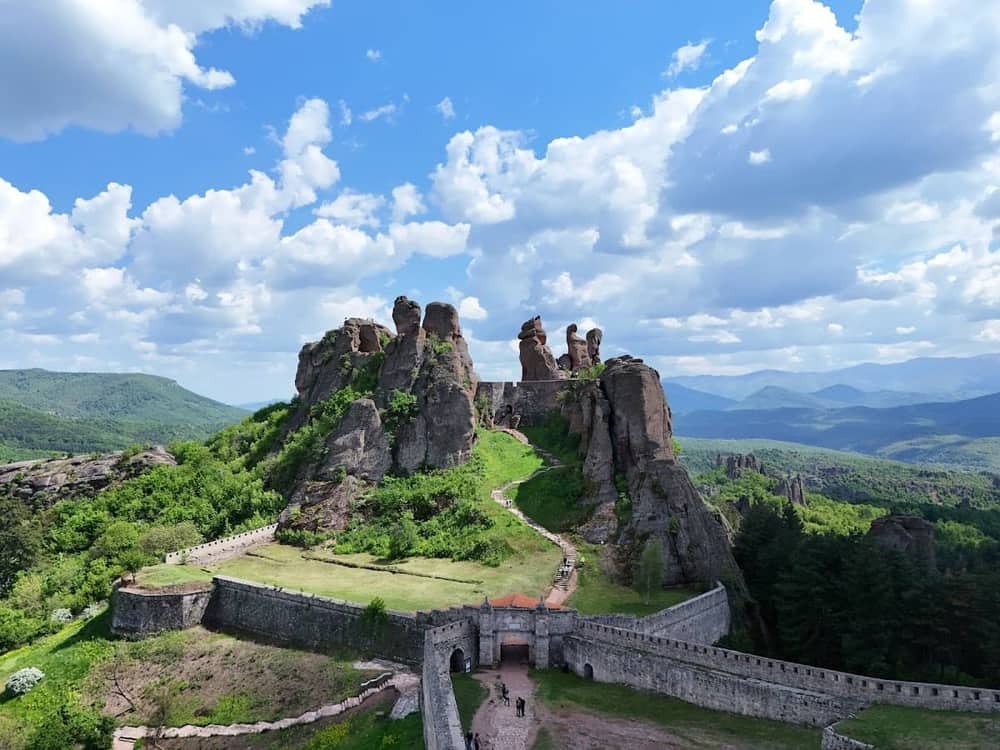
Near Primorsko on the southern coast, a short distance from resorts such as Sozopol or the great sprawl of Sunny Beach, the forest hides Begliktash — a Thracian megalithic sanctuary of enormous stone blocks arranged for ritual, a gateway dolmen one passed through symbolically, and astronomical markings tied to the solstices.
This is a different kind of visit from a museum: a walk through woodland among stones that hum with an old energy. For anyone holidaying on the sea — whether at Sozopol, Pomorie, Sveti Vlas, or further up toward Varna and Golden Sands — Begliktash is the easiest doorway into the Thracian world, just a few dozen minutes from the beach.
The Madara Horseman: the rider in the cliff
Near Shumen in the north-east, the Madara Horseman (UNESCO, 1979) is a monumental relief carved more than 20 metres up a sheer cliff face: a rider spearing a lion, a dog running behind. Dated to around 710 AD, it already belongs to the First Bulgarian Empire, not to the Thracians — but the tradition of the hero-rider, so deeply rooted in Thracian art (think of the countless votive plaques of the Thracian Horseman in Bulgaria's museums), finds its grandest echo here. It is a work that binds together the civilisations layered on this land.
Tracing the Thracians across the country
The Thracians have no single city to visit — they are scattered across the whole map. A few logical hubs:
- Sofia — the National Museum of History: your starting point for treasures and context.
- Plovdiv — one of Europe's oldest continuously inhabited cities, founded on a Thracian settlement (Eumolpia), with a rich archaeological museum; an ideal base for the centre of the country.
- Kazanlak / Rose Valley — the painted tomb plus rose culture.
- Kardzhali / Rhodopes — Perperikon and other rock sanctuaries.
- Shumen / Isperih (north-east) — Madara and Sveshtari, close to each other.
- Southern coast (Primorsko / Sozopol) — Begliktash, for those mixing beach with history.
Many sites are out in nature and require walking; go in the morning before the heat, and carry water.
Practical notes for the road
- The Romania–Bulgaria border is part of the Schengen area: there is no longer any passport or ID check at the land crossing. You pass through essentially without stopping.
- The currency is now the euro. The lev still circulates in parallel during the transition, but prices are in euro.
- A mandatory electronic vignette is required on Bulgarian roads — buy it online or at petrol stations before joining the main routes. Without it you risk a fine.
- Fuel costs around 2 euro per litre (petrol and diesel, indicative).
- Distances between sites are long and the mountain roads (Rhodopes) eat up time; don't overpack your day. Check museum opening times in advance — many have closing days and seasonal hours (indicative).
Why it matters
The Thracians vanished as a distinct people, absorbed by Romans, Greeks and later by Slavs and Bulgars. But their art — the gold, the frescoes, the sanctuaries — remains one of the most refined legacies of European antiquity, long underrated. To discover it in Bulgaria, far from the well-trodden circuits, is to meet a civilisation that chose to speak through beauty rather than words. And which, two and a half thousand years on, still manages to.
FAQ
Where can I see the most important Thracian gold treasures? The anchors are the National Museum of History in Sofia and the Archaeological Museum in Varna. Look for the Panagyurishte Treasure (nine solid-gold vessels) and the Valchitran one; check before you travel where the original is shown, as the major pieces often go on international tour (indicative).
Which Thracian tombs are UNESCO-listed? The painted Tomb of Kazanlak (4th century BC, UNESCO since 1979) in the Rose Valley, with its princely funeral banquet — the original is sealed, but an exact replica is open to visitors. The second is the Getic Tomb of Sveshtari (3rd century BC, UNESCO since 1985), unique for its ten caryatids.
What is Perperikon? Perperikon, in the Rhodopes near Kardzhali, is Bulgaria's most spectacular megalithic site — a sanctuary-city cut straight into the rock, linked by tradition to the oracle of Dionysus. The visit needs good footwear and a few hours of climbing stone stairs, often under full sun.
Can I combine Thracian history with a beach holiday? Yes — near Primorsko, just a few dozen minutes from Sozopol or Sunny Beach, the forest hides the Begliktash megalithic sanctuary, the easiest doorway into the Thracian world from the coast. Distances between sites are long and mountain roads eat time, so don't overpack your day.